
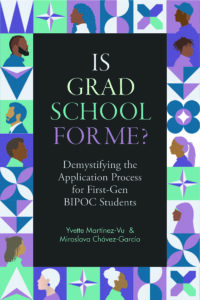
Is Grad School For Me? Demystifying the Application Process for First-Gen BIPOC Students (UC Press, 2024)
ORDER ONLINE AND SAVE 30%: Use UCPSAVE30 at checkout
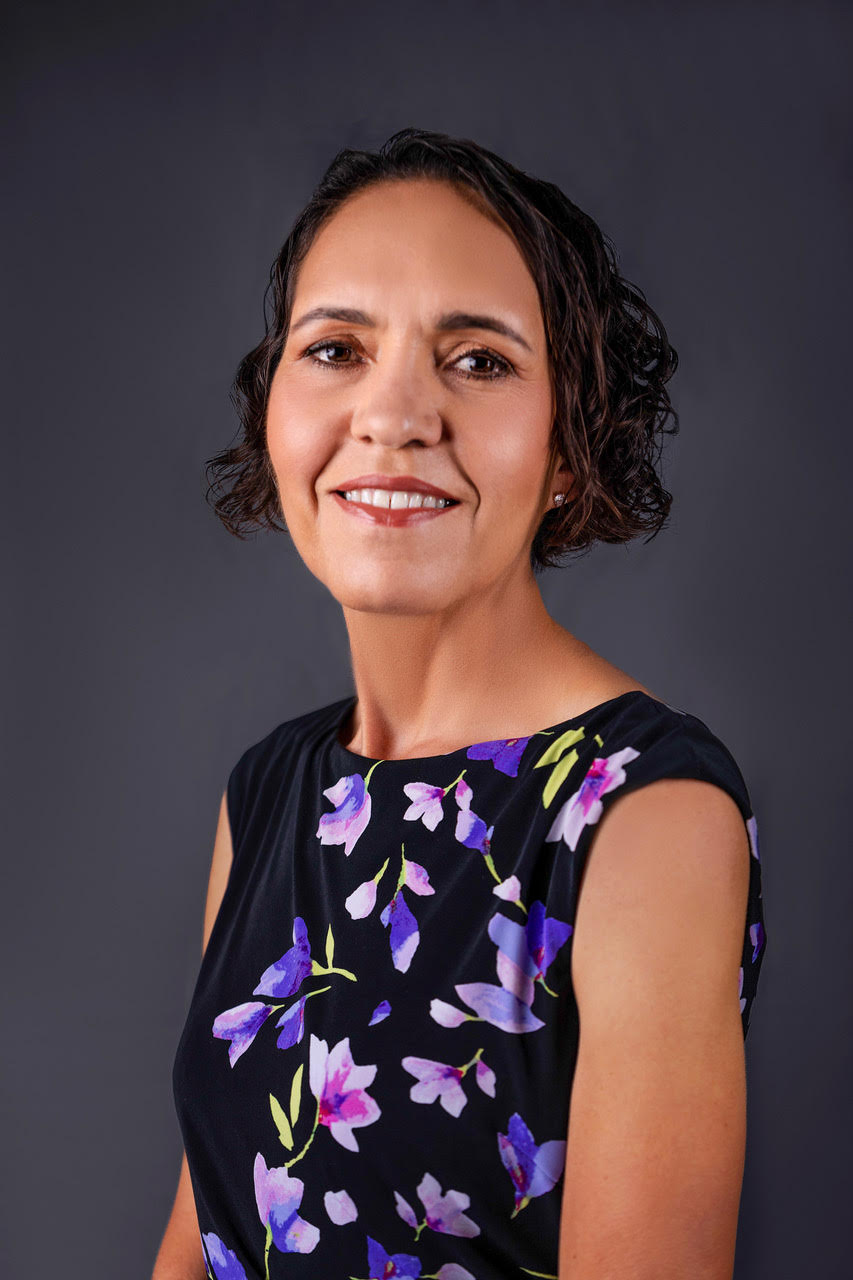
Miroslava Chávez-García is Professor of History at the University of California, Santa Barbara, and holds affiliations in the Departments of Chicana/o Studies and Feminist Studies as well as Iberian and Latin American Studies.
Mission Statement
My mission is to expand access and create pathways for equitable opportunities and social justice.
Core Values
Mentorship; Accessibility; Growth; Community; Transparency
Author of Negotiating Conquest: Gender and Power in California, 1770s to 1880s (University of Arizona Press, 2004) and States of Delinquency: Race and Science in the Making of California’s Juvenile Justice System(University of California Press, 2012), and Migrant Longing: Letter Writing across the U.S.-Mexico Borderlands (University of North Carolina Press, 2018), her latest academic book is a history of transnational migration, gender, courtship, and identity as told through more than 300 personal letters exchanged among family members and friends across the U.S.-Mexico borderlands. In 2020, Migrant Longing was named a 2019 Choice Outstanding Academic Title and in 2019 it received the Barbara “Penny” Kanner Award from Western Association of Women’s Historians (WAWH). In 2017, “Migrant Longing, Courtship, and Gendered Identity in the U.S.-Mexico Borderlands,” published by the Western History Quarterly in Summer 2016, received the Judith Lee Ridge from the WAWH. In the same year, that essay was also awarded the Bolton-Cutter Award from the Western History Association for the best article on Spanish Borderlands history. She is also author of numerous journal articles and book chapters as well as reviews and commentaries.
Miroslava has received awards and fellowships from the Center for Advanced Studies in the Behavioral Sciences and from the Center for Comparative Studies in Race and Ethnicity, both at Stanford University, from the Ford Foundation, and from the Organization of American History (OAH), the Committee for the Germany Residency Program, which awarded her a residency at the University of Tübingen. Miroslava has also mentored many students and colleagues throughout the academic pipeline and beyond. She has served on numerous boards and committees.
A first-generation, immigrant, Chicana of farm worker origins, Miroslava was born on the U.S.-Mexico border, in Mexicali, Baja California, and was raised in San Jose, California, where she attended K-12, graduating from Notre Dame, San Jose, in 1986. She received her B.A. (1991), M.A. (1993), and Ph.D. (1998), from UCLA.
Architect of Hate: Garrett Hardin and the Rise of Eco-fascism in Modern America
Few people realize that Project 2025, the comprehensive blueprint for President Donald Trump’s second administration, is historically rooted in deeply-held conservative values about finite resources and who deserves and who does not deserve the right to enjoy them. Whether gaining access to the natural environment or lawful entry to the United States, the Trump Administration has taken a page out of the playbook of influential eco-fascist ideologues of the twentieth century, including Garrett Hardin. A professor of ecology turned popular science writer and lifelong student of Reverend Thomas R. Malthus’s 1798 theory on the limits of population, Hardin spent a lifetime arguing for the need to restrict national as well as global populations lest we have famine, war, and chaos descend upon our shores.
Hardin was especially concerned with the quality, not just the quantity, of populations, arguing that the disabled and people from the Global South, including African Americans, Mexicans, and Indians, threatened the American way of life. To protect the national patrimony, Hardin teamed up with a vast network of similarly minded idealogues who worked together to devise state and national policies aimed at preventing the “tragedy of the commons,” a concept Hardin popularized in the second half of the twentieth about people’s exploitation of unmanaged resources and the need to restrict them from doing so. That essay, as well as numerous other writings, speeches, and public appearances, worked to convince people at all levels of society to limit and, ideally, eliminate immigrant, disabled, and racially and ethnically diverse communities in the United States. This (in-progress) book project demonstrates Hardin’s influence in society by focusing on how and why as well as when and where Hardin and his peers carried out their vision for a white supremacist, able-bodied, heteronormative, zero-population growth America and how political leaders in the twenty-first century grabbed onto his extremist beliefs on population control, the environment, immigration, and scientific racism.
Books/Edited Books
Is Grad School for Me? Demystifying the Application Profess for First-Gen BIPOC Students, co-author, with Yvette Martínez-Vu. Berkeley: University of California Press, 2024.
Migrant Longing: Letter Writing across the U.S.-Mexico Borderlands. Chapel Hill: University of North Carolina Press, 2018.
- 2019 Barbara “Penny” Kanner Award, Western Association of Women’s Historians
- 2019 Choice Outstanding Academic Title
States of Delinquency: Race and Science in the Making of California’s Juvenile Justice System. Berkeley: University of California Press, 2012.
Negotiating Conquest: Gender and Power in California, 1770s to the 1880s. Tucson: University of Arizona Press, 2004.
Edited Book and Journal
Editor, Latina Lives, Latina Narratives: Influential Essays by Vicki L. Ruiz. New York: Routledge, Taylor & Francis, 2021.
Co-Editor, Special Issue, “Gender and Intimacy Across the U.S.-Mexico Borderlands,” Pacific Historical Review (Winter 2020), with Verónica Castillo-Muñoz.
Articles
- “Framing Defectives, Affirming Science: Critical Archival Research on Eugenic Field Worker Case Files.” Co-author with Isidro Gonzalez In Sage Research Methods Cases: Diversifying and Decolonizing Research. London: Sage Publications Ltd., 2023. https://doi.org/ (March 2024).
- “From ‘Tough Love’ to ‘Street Fight’: Garret Hardin and Cordelia S. May’s Battle for Population Control and Eugenics at the Turn of the Millenium,” Revista Brasileira de História. São Paulo, 2023, http://dx.doi.org/10.1590/1806-93472023v43n94-10.
- “The Architects of Hate: Garrett Hardin’s and Cordelia S. May’s Battle for Population Control, Environmentalism, and Immigration Restriction.” Journal of American Ethnic History 43 (Fall 2023): 88-117.
- “Foreword” to Robert W. Griffith, Ike’s Letters to a Friend, 1941–1958. Lawrence: University Press of Kansas, 2021 e-book edition.
- “Opioids and Marijuana in the United States: Where We’ve Been, Where We’re Headed,” in USA Country Report/Länderbericht USA. Berlin: German Federal Agency for Civic Education, 2020.
- “Navigating Successfully Grants and Fellowships Applications,” co-author with Luis Alvarez and Ernesto Chávez, in The Academic’s Handbook, 4th ed., revised and expanded, eds. Lori Flores and Jocelyn Olcott (Duke University Press, 2019).
- “Youth, Evidence, and Agency: Mexican and Mexican American Youth at the Whittier State School, 1880-1920 (reprint).” In, The Chicana/o Education Pipeline: History, Institutional Critique, and Resistance, 23-47, eds. Michaela J. L. Mares-Tamayo and Daniel G. Solorzano. Los Angeles: Chicano Studies Research Center, UCLA, 2018.
- “A Genealogy of Chicana History, the Chicana Movement, and Chicana Studies.” In, Routledge Handbook of Chicana/o Studies, eds. Denise Segura, Francisco Lomelí, Elyette Benjamin-Labarthe. New York: Routledge International Handbooks, 2018.
- “Strategies for Publishing in the Humanities: A Senior Professor Advises Junior Scholars,” The Journal of Scholarly Publishing, 48, no. 4 (July 2017): 199-220.
- “Migrant Longing, Courtship, and Gendered Identity in the Borderlands,” Western Historical Quarterly Vol. 47, no. 2 (Summer 2016): 137-160.
- Winner, Bolton-Cutter Prize, Western History Association, 2017
- Winner, Judith Lee Ridge Prize, Western Association of Women’s Historians, 2017.
- “Chicana and Chicano Historians Reflect on the Model Mentorship of Norris Hundley, Jr.” In, Passing the Torch: Mentoring in the Social Sciences, 39-50, ed. by Frank A. Salamone and Marjorie Snipes. Cambridge Scholars Press, 2016.
- “States of Incarceration,” with Mayela Caro, Marissa Friedman, and Sonia Mehrmand, Boom: The Journal of California, Vol. 6, No. 2 (Summer 2016): 36-41.
- “Youth of Color and California’s Carceral State: The Fred C. Nelles Correctional Facility,” Journal of American History, The Carceral State, Vol. 102, No. 1 (June 2015): 47-60. http://jah.oxfordjournals.org/cgi/content/full/jav197?ijkey=yy5I21mXXTMoPmj&keytype=ref
- “Future Academics of Color in Dialogue: A Candid Q&A on Adjusting to the Cultural, Social, and Professional Rigor of Academia,” co-author with Mayra Avitia and Jorge N. Leal, in Beginning a Career in Academia: A Guide for Graduate Students of Color, 128-145, ed. by Dwayne Mack et al. New York: Routledge/Taylor and Francis Group, 2014.
- “Latina/o Youth Gangs in Global Perspective,” in East Meets West Perspectives in Juvenile Delinquency, pp. 93-118, ed. by Heather Ellis. Palgrave Macmillan, 2014.
- “The Interdisciplinary Project of Chicana history: Looking Back, Moving Forward,” Special Issue on Chicana/o History, Pacific Historical Review Vol. 82, No. 4 (2013): 542-65.
- “Hispanic Women and the Law.” In, Latinas in the U.S., eds. Vicki L. Ruiz and Virginia Sánchez-Korrol, 700-703. Bloomington: Indiana University Press, 2006.
- “Race, Culture, and Justice in Mexican Los Angeles.” (Reprint). In, Unequal Sisters: An Inclusive Reader in U.S. Women’s History, 108-117, ed. by Vicki L. Ruiz with Ellen C. DuBois. New York: Routledge, 2008, 4th ed.“
- In Retrospect: Anthony M. Platt’s The Child Savers: The Invention of Delinquency (1969, 1977),” Reviews in American History 35 (September 2007): 464-81.
- “Intelligence Testing at Whittier State School, 1891 to 1920,” Pacific Historical Review, 76, no. 2 (May 2007): 193-228.
- “Youth, Evidence, and Agency: Whittier State School and Mexican and Mexican American Youth” Aztlán: A Journal of Chicano Studies, 31 (Fall 2006): 55-83.
- “Californians Loss of Land After U.S. Annexation in 1848 (reprint).” In, Major Problems in Latina/o History, 1st edition, ed. by Omar Valerio-Jiménez and Carmen Teresa Whalen, 55-63. Stamford, CT: Cengage Learning, 2014.
- “Women’s Studies and Chicana Studies: Learning from the Past, Looking to the Future.” Co-author with Monica Brown. In Women’s Studies for the Future: Foundations, Interrogations, Politics, eds. Liz Kennedy & Agatha Beins, 143-155. Piscataway, NJ: Rutgers Univ. Press, 2005.
- “An Interview with Yolanda Cruz: A Filmmaker Documents Depopulation in Mexico,” Boom: California Studies Journal, 1, no. 3 (September 2011): 57-61
- “Guadalupe Trujillo: Race, Culture, and Justice in Mexican Los Angeles.” In, The Human Tradition in California, eds. Clark Davis and David Igler, 31-46. Wilmington, DE: Scholarly Resources, 2002.
- “The Gwin Commission.” In, Oxford Encyclopedia of Latinos and Latinas in the U.S., eds. Suzanne Oboler and Deena J. González, 257-58. New York: Oxford University Press, 2005.
- “‘The Crime of Precocious Sexuality’ Celebrates Thirty Years: A Critical Appraisal,” Journal of the History of Childhood and Youth, Symposium, “The Crime of Precocious Sexuality,” 2 (Winter 2009): 88-94
- “In Retrospect: Anthony M. Platt’s The Child Savers: The Invention of Delinquency (1969, 1977).” (Reprint). Introduction to The Child Savers: The Invention of Delinquency, Expanded 40th Anniversary Edition, xi-xxxv, by Anthony M. Platt with an introduction and critical commentaries compiled by Miroslava Chávez-García. New Brunswick: Rutgers University Press, 2009.
- “A Chicana Scholar’s Long Road to Engaging in Public Scholarship,” Western Humanities Association Journal, 64, no. 3 (2011): 77-80.
- “‘Pongo mi demanda‘: Challenging Patriarchy in Mexican Los Angeles, 1830-1850.” In Over the Edge: Remapping the American West, eds. Valerie Matsumoto and Blake Almendinger, 272-290. Berkeley: University of California Press, 1998.
- 2025-26 Andrew W. Mellon Foundation Fellowship at the Center for Advanced Study in the Behavioral Sciences, Stanford University
- Society of American Historians, member, 2024-present.
- Bolton-Cutter Prize, Best Essay in Spanish/Borderlands History, Western History Association, 2017
- Judith Lee Ridge Prize, Best Essay, Western Association of Women’s Historians, 2017
- Organization of American History (OAH) Germany Residency Program, Summer 2016